What Size Kubota Mower Do I Need?
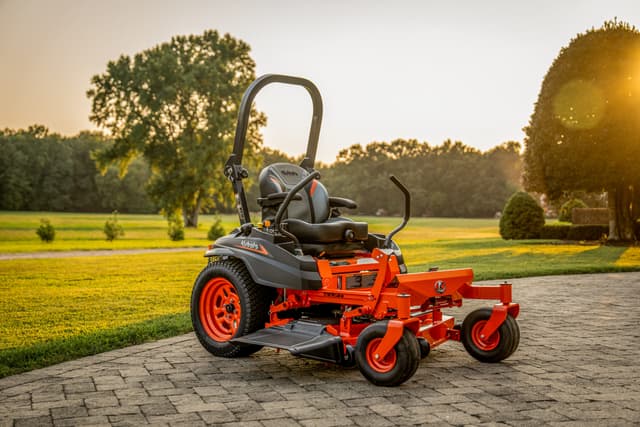
Wondering what size Kubota mower you need? Choosing the right mower isn't as simple as looking at how many acres you have.
A homeowner mowing two acres with trees, landscaping, and tight spaces may need a very different mower than someone mowing five acres of wide-open grass.
The right Kubota mower depends on several factors, including:
Kubota's current zero-turn mower lineup includes deck sizes from 42 to 72 inches, depending on the series and model.
So, what size Kubota mower do you actually need?
Let's break it down.
Start With Your Property, Not Just Your Acreage
Acreage is important, but it shouldn't be the only factor you consider.
Two properties with the same acreage can require completely different mowers.
For example, imagine two 3-acre properties.
The first property is mostly open grass with very few obstacles.
The second has dozens of trees, landscaping beds, fences, buildings, and narrow areas.
The second property may actually be easier and faster to mow with a smaller deck because maneuverability is more important.
Kubota recommends considering the space between obstacles when determining an appropriate deck size. If the mower is too large for certain areas, you may have to finish those areas with another mower or trimming equipment.
That's why the best mower size isn't determined by acreage alone.
Kubota Mower Deck Sizes
Kubota offers a wide range of zero-turn mower deck sizes.
Depending on the series, you can find:
- 42-inch decks
- 48-inch decks
- 54-inch decks
- 60-inch decks
- 72-inch decks
The Z200 Series includes 42-, 48-, and 54-inch options. The Z400 Series includes 48-, 54-, and 60-inch options. The ZG Series offers 48-, 54-, and 60-inch decks, while the larger ZD Series reaches 72 inches.
The question is which size makes the most sense for your property.
Is a 42-Inch Kubota Mower Right for Me?
A 42-inch deck can be a good choice when maneuverability is one of your biggest priorities.
The Kubota Z232KW-42 is part of the Z200 Series and uses a 42-inch deck with a 21.5-horsepower Kawasaki engine. Kubota positions the Z200 Series as its residential zero-turn mower lineup.
A smaller deck can be especially useful when you're mowing around:
- Trees
- Flower beds
- Landscaping
- Fences
- Buildings
- Gates
- Narrow passages
If your property is relatively small but has a lot of obstacles, don't automatically assume you need a larger deck.
A 42-inch mower may allow you to get into areas where a larger machine can't.
Who Should Consider a 42-Inch Mower?
A 42-inch mower may be worth considering if:
- You have a smaller residential property.
- Your yard has numerous obstacles.
- You have narrow areas to mow.
- Maneuverability is more important than maximum mowing width.
- You want a compact zero-turn mower.
The Z232KW-42 gives homeowners a compact Kubota zero-turn option while still providing the maneuverability that makes zero-turn mowers so popular.
Is a 48-Inch Kubota Mower Right for Me?
A 48-inch deck is a versatile middle ground.
In the Z200 Series, the Z242KW-48 uses a 48-inch deck and 21.5-horsepower Kawasaki engine. The Z400 Series also offers the Z412KWNC-48 with a 48-inch deck and Kawasaki power.
A 48-inch mower gives you more cutting width than a 42-inch machine while remaining relatively maneuverable.
It can be a good choice when you have a mixture of open lawn and obstacles.
Who Should Consider a 48-Inch Mower?
Consider a 48-inch mower if:
The Z242KW-48 and Z412KWNC-48 are two different approaches to the 48-inch category, giving customers options depending on how much mower they need and the type of work they're doing.
Is a 54-Inch Kubota Mower Right for Me?
A 54-inch deck gives you another step up in mowing width.
Kubota offers 54-inch configurations across several of its zero-turn families.
The Z200 Series includes the Z252KW-54, while the Z400 Series includes the Z422KWNC-54 and Z452KWi-54. The ZG Series also offers 54-inch configurations.
The additional width can help you cover more ground with each pass when mowing larger open areas.
But there is an important tradeoff.
A wider deck requires more room.
If your yard is filled with trees, landscaping, fences, and other obstacles, you may spend more time maneuvering around those obstacles.
Who Should Consider a 54-Inch Mower?
A 54-inch mower may make sense if:
Is a 60-Inch Kubota Mower Right for Me?
A 60-inch deck is designed to cover substantial ground with every pass.
Kubota offers 60-inch configurations in the Z400, ZG, Z700, and ZD Series.
For the Z400 Series, the Z422KWTNC-60 and Z452KWTi-60 provide 60-inch options with Kawasaki engines.
The ZG Series also offers the ZG227LA-60 and ZG327PA-60.
For customers looking for a larger commercial zero-turn mower, the Z781 lineup includes 60-inch configurations such as the Z781KWiTW-60 and Z781KWTi-60.
Who Should Consider a 60-Inch Mower?
A 60-inch mower may be a good fit if:
A 60-inch deck can be an excellent choice when the property gives you enough room to take advantage of the additional mowing width.
Is a 72-Inch Kubota Mower Right for Me?
A 72-inch deck is a serious mowing tool.
Kubota offers 72-inch configurations in the ZD Series, including the ZD1211L-72, ZD1211RL-72R, and ZD1611 configurations.
The ZD1611 can be equipped with a 60-inch rear-discharge deck, 72-inch rear-discharge deck, or 72-inch side-discharge deck. Kubota's ZD1611 uses a 30.8-horsepower Kubota diesel engine.
A 72-inch deck can make sense when you're mowing large, open areas and need to maximize productivity.
But this isn't a mower size you should choose simply because you have a lot of acreage.
You need enough open space to take advantage of the larger cutting width.
Who Should Consider a 72-Inch Mower?
A 72-inch mower may make sense for:
- Commercial mowing contractors
- Large properties
- Municipal mowing
- Farms and large estates
- Large open turf areas
- Professional operators
If most of your property is open and relatively flat, the larger deck can help you cover more ground.
If you're mowing around dozens of obstacles, a smaller mower may be a better choice.
How Many Acres Can a Kubota Mower Cut?
This is one of the most common questions people ask.
The problem is that there isn't one acreage number that applies to every mower or property.
Your actual mowing time depends on much more than the size of the property.
Consider:
A wide-open 5-acre property can be much faster to mow than a heavily landscaped 2-acre property.
That's why you shouldn't choose your Kubota mower based solely on an acreage number.
How Much Does Deck Size Affect Mowing Time?
Deck size affects how much grass you cut with each pass.
A 60-inch deck covers more width than a 48-inch deck.
That doesn't necessarily mean it will always finish the job faster.
If you're constantly stopping, turning, backing up, or maneuvering around obstacles, some of the advantage of the larger deck disappears.
The goal is to find the deck size that lets you cover open areas efficiently without making the rest of your property difficult to mow.
How Much Does Horsepower Matter?
Horsepower matters, but it shouldn't determine your mower size by itself.
Kubota's current zero-turn lineup ranges from the 21.5-horsepower Kawasaki-powered Z200 models to larger gasoline and diesel machines designed for more demanding applications.
When comparing horsepower, also consider:
- Deck size
- Grass conditions
- Terrain
- Mowing frequency
- Desired ground speed
- Residential vs. commercial use
A larger deck can require an engine and mower system capable of handling the cutting load, particularly in thick or demanding grass.
That's why it's better to consider the entire mower rather than looking at horsepower alone.
What Kubota Mower Series Should I Consider?
Once you've figured out the deck size you need, the next question is which Kubota series makes sense.
Kubota Z200 Series
The Z200 Series is Kubota's residential zero-turn mower lineup.
For customers looking specifically at Kawasaki-powered models, the current options include:
- Z232KW-42 — 42-inch deck, 21.5 HP
- Z242KW-48 — 48-inch deck, 21.5 HP
- Z252KW-54 — 54-inch deck, 24 HP
Kubota describes the Z200 as its residential zero-turn mower and offers fabricated welded decks from 42 to 54 inches.
The Z200 can be a strong choice for homeowners and property owners who want zero-turn maneuverability for residential mowing.
Kubota Z400 Series
The Z400 Series gives customers more options as they move into larger decks and higher-performance configurations.